
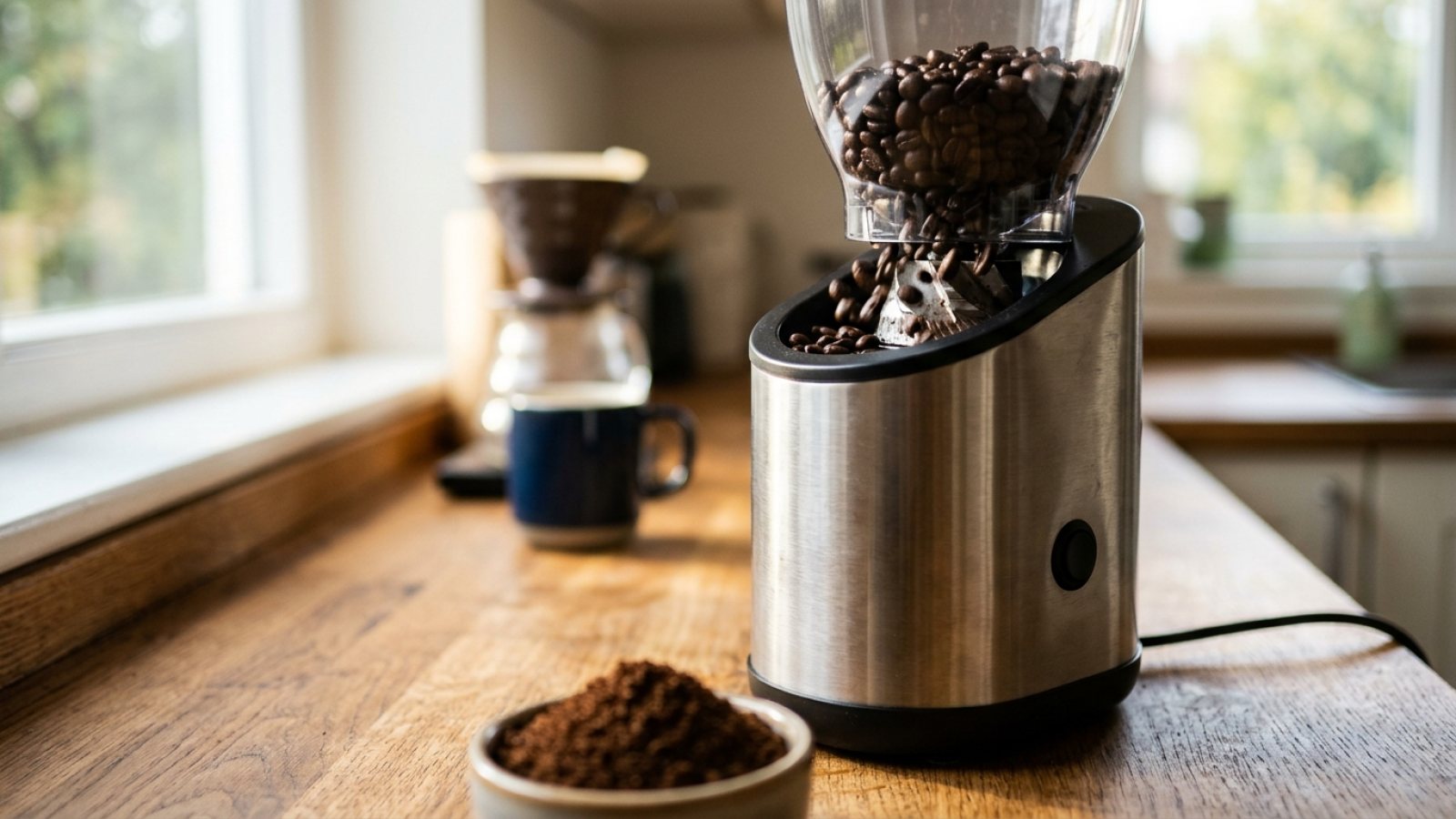
Burr Grinder vs. Blade Grinder: Why Uniformity Matters More Than Speed for Your Morning Cup
The single most overlooked variable in brewing exceptional coffee is grind uniformity. Blade grinders chop beans into an inconsistent mess, while burr grinders deliver the precision necessary for true flavor extraction.
The difference between a good cup of coffee and a truly great one often boils down to a single, critical variable: the grind. Forget expensive beans or exotic brewing methods if your grinder is failing you. A blade grinder is not a grinder at all; it is a blender, a chopper, a coffee annihilator. If you seek flavor, consistency, and control, the burr grinder is the only option.
The Fundamental Flaw of the Blade Grinder
Blade grinders, common in many kitchens due to their low cost and small footprint, operate on the principle of impact. A spinning blade, much like a propeller, hacks away at the coffee beans. This process is inherently flawed. It does not produce a uniform grind, but rather a chaotic mix of boulders and dust.
Consider the consequences. When you brew coffee with this heterogeneous mixture, the tiny dust particles over-extract almost instantly, releasing bitter, acrid notes. Simultaneously, the large, chunky particles under-extract, contributing sour, underdeveloped flavors. The resulting cup is muddy, unbalanced, and devoid of the nuanced aromatics inherent in the bean. This is why a coffee brewed from pre-ground supermarket beans often tastes stale and disappointing, regardless of its origin. The damage is done at the point of grinding.
The Precision of the Burr Grinder
A burr grinder, by contrast, operates with precision. It crushes coffee beans between two abrasive surfaces, known as burrs. These burrs are carefully machined to create a consistent gap, ensuring that nearly every particle of coffee meets the desired size specification. This mechanical process delivers a uniform grind, particle after particle.
Burr grinders come in two primary types: conical and flat. Conical burrs, often found in home grinders like the Baratza Encore or the manual Comandante C40, are praised for their efficiency, lower retention, and suitability for various brew methods. Flat burrs, common in high-end espresso grinders and some professional models like the Niche Zero, are known for their extreme precision, often favored for espresso where absolute consistency is paramount. Materials matter too; steel burrs offer sharpness and durability superior to most ceramic options.
This uniformity is not an academic nicety; it is the bedrock of proper extraction. When all coffee particles are roughly the same size, water flows through the coffee bed evenly, extracting flavor compounds at a predictable rate. This leads to a clean, balanced, and complex cup that showcases the true character of the coffee bean.
Matching Grind to Method: A Craft, Not a Compromise
Different brewing methods demand specific grind sizes, and a burr grinder allows you to dial in that precision. Without it, your carefully chosen method is compromised.
- Espresso: This method is perhaps the most sensitive to grind size. Espresso requires an extremely fine and perfectly uniform grind, typically in the range of 250-350 microns, resembling powdered sugar but without clumping. An inconsistent grind here leads to channeling – water carving paths through the coffee bed, resulting in wildly uneven extraction, sour notes from under-extraction, or bitter ones from over-extraction.
- Pour-Over (e.g., Hario V60, Chemex): For pour-over, a medium-fine to medium grind, similar to sea salt, is ideal. The precise grind ensures even water flow through the Hario V60 cone or Chemex filter. Too fine, and the bed chokes, extending brew time and over-extracting. Too coarse, and the water rushes through, resulting in a weak, sour cup. Water temperature is critical too, typically between 200-205°F for optimal extraction.
- French Press: This immersion method thrives on a coarse, uniform grind, resembling breadcrumbs. The coarseness minimizes fines that would otherwise pass through the mesh filter, contributing bitterness and sludge to the final cup.
- Moka Pot: A fine grind, slightly coarser than espresso, is required for the moka pot. Uniformity prevents channeling in the coffee bed and ensures that the pressurized steam extracts evenly, yielding a strong, rich brew.
- Turkish Coffee: The most demanding grind, pulverized to an almost flour-like consistency. Even at this extreme, a burr grinder ensures minimal clumping and a silky smooth texture when suspended in the water, a cornerstone of traditional Turkish preparation.
The investment in a quality burr grinder—whether manual or electric—is perhaps the single most impactful upgrade you can make to your home coffee setup. It unlocks the true potential of your beans and your brewing equipment, transforming every morning cup from merely good to consistently exceptional. Focus on uniformity, not just speed; your palate will thank you.
