
Beyond 'Good Coffee': How to Start Cupping Like a Pro to Uncover Hidden Flavors
Move past simply calling coffee 'good.' Learn the standardized ritual of cupping to objectively evaluate beans and unlock a spectrum of complex flavors.
Most people consider a coffee “good” if it’s hot, caffeinated, and doesn't taste burnt. That’s a low bar. Real coffee drinkers, the ones who chase clarity and nuance, understand that “good” is a starting point, not a destination. To move beyond vague appreciation and truly understand what makes a coffee exceptional, you must learn to cup. Cupping is the professional method for evaluating coffee, a standardized ritual that peels back layers of flavor, revealing the true character of the bean. It’s not just for Q Graders; it’s for anyone serious about what’s in their mug.
The Setup: Standardization is Key
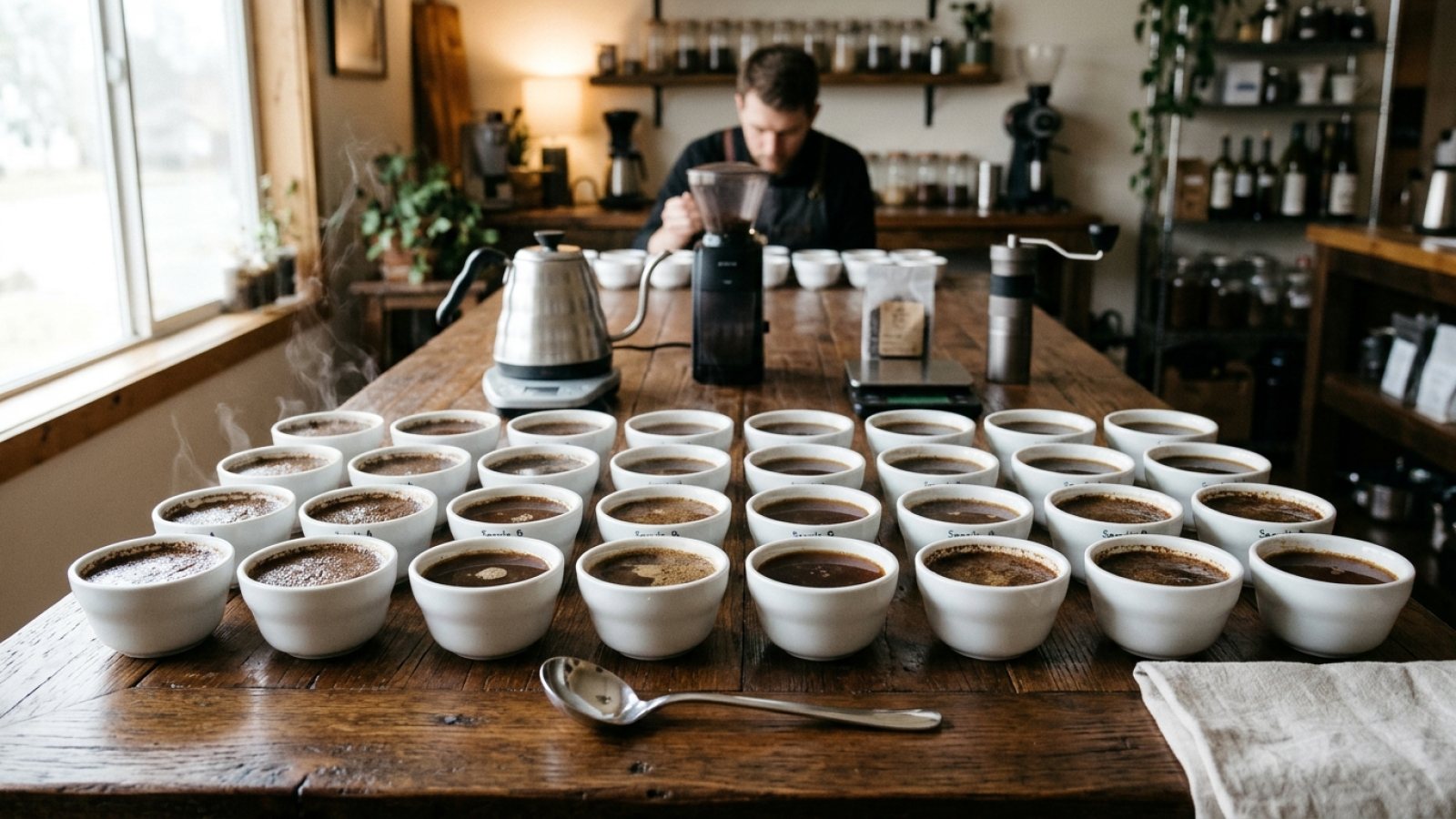
The foundation of effective cupping is consistency. Every variable must be controlled to isolate the coffee's inherent qualities. You will need a few things: ceramic cupping bowls (typically 5-7 oz, white interior for color assessment), deep cupping spoons made of non-reactive metal, a precise burr grinder, a digital scale, and a kettle capable of accurate temperature control. Forget your everyday mug; the bowls ensure uniform heat retention and aroma capture.
Grind size is critical. Aim for a coarse, uniform grind, resembling coarse sea salt. Too fine, and you over-extract; too coarse, you under-extract. Consistency here allows for an even infusion. Weigh your coffee precisely: the standard ratio is 1:18, meaning 8.25 grams of coffee for 150ml of water per cup. If you're comparing multiple coffees, like a bright Ethiopian Yirgacheffe against a rich Colombian Supremo, use identical amounts. Your water temperature must be exact, too: 200-205°F (93-96°C) is the sweet spot, just off a rolling boil. Anything less risks under-extraction, anything more scalds the grounds. For serious evaluations, use filtered water to eliminate off-flavors.
The Ritual: Breaking the Crust and Tasting
Once your grounds are in the bowls, pour the hot water evenly over them, saturating every particle. Start a timer. The coffee will bloom, forming a thick crust on the surface. Allow it to steep undisturbed for exactly four minutes. This steeping phase extracts soluble solids and aromatic compounds. After four minutes, it’s time to "break the crust." Gently push your cupping spoon through the floating grounds, pushing them towards the back of the bowl. As you do, bring your nose close to the surface. This is where the true aroma bursts forth – citrus, floral, chocolate, nutty notes. Clear away any remaining foam and floating grounds with two spoons.
Now, the tasting begins. Wait another 5-10 minutes for the coffee to cool to a palatable temperature, typically around 160°F (70°C). Scoop a small amount onto your cupping spoon and slurp it forcefully. The slurp isn't for show; it atomizes the coffee, distributing it across your entire palate and aerating it to release volatile aromatics. Focus on distinct flavor attributes: sweetness, acidity, body (mouthfeel), and aftertaste. Is the acidity bright like a crisp apple, or mellow like dark chocolate? Is the body full and creamy, or light and tea-like? Professional tasters, much like the relentless pursuit of perfection seen in Jiro Dreams of Sushi, develop an acute sense of discernment over years of practice. Note every impression. Repeat for each cup, ideally comparing three cups of the same coffee for consistency and multiple different coffees side-by-side.
Beyond the Score: What Cupping Teaches
Cupping is more than just assigning a numerical score; it’s a journey in sensory development. It trains your palate to discern subtle differences that would otherwise go unnoticed. You’ll begin to identify roast defects – a smoky taste from an over-roasted bean, or a grassy, undeveloped note from an under-roasted one. You’ll understand why a washed Ethiopian coffee delivers bright, floral notes and a clean finish, while a natural process Brazilian might present with jammy fruit and a heavier body. This practice connects you intimately with the journey of the bean, from farm to roaster to cup. You learn to appreciate the labor, the terroir, and the craft involved in creating exceptional coffee.
It’s not about becoming a certified Q Grader overnight. It’s about elevating your daily coffee experience, moving from passive consumption to active appreciation. By applying this structured approach, you unlock a lexicon of flavors, turning a simple morning ritual into an ongoing education. The stainless moka pot beats the aluminum for a reason, just as understanding extraction nuances beats guesswork. Cupping is your direct path to truly knowing your coffee.
