
Pulling the Perfect Home Espresso Shot: Tamping, Pre-Infusion, and the Golden Ratio
Achieving cafe-quality espresso at home depends on mastering three fundamental steps: precise tamping, controlled pre-infusion, and the appropriate golden ratio. This guide unpacks each element to elevate your daily shot.
The elusive home espresso shot is not a myth, nor is it purely the domain of high-end cafes. It's a craft, perfected by understanding three critical elements: tamping, pre-infusion, and the golden ratio. Ignore any one, and your pursuit of crema and balanced flavor will inevitably fall short. Espresso is an exercise in controlled extraction, where variables are manipulated to coax the best from the bean. This isn't about expensive gear alone; it's about technique.
The Foundation: Precise Tamping
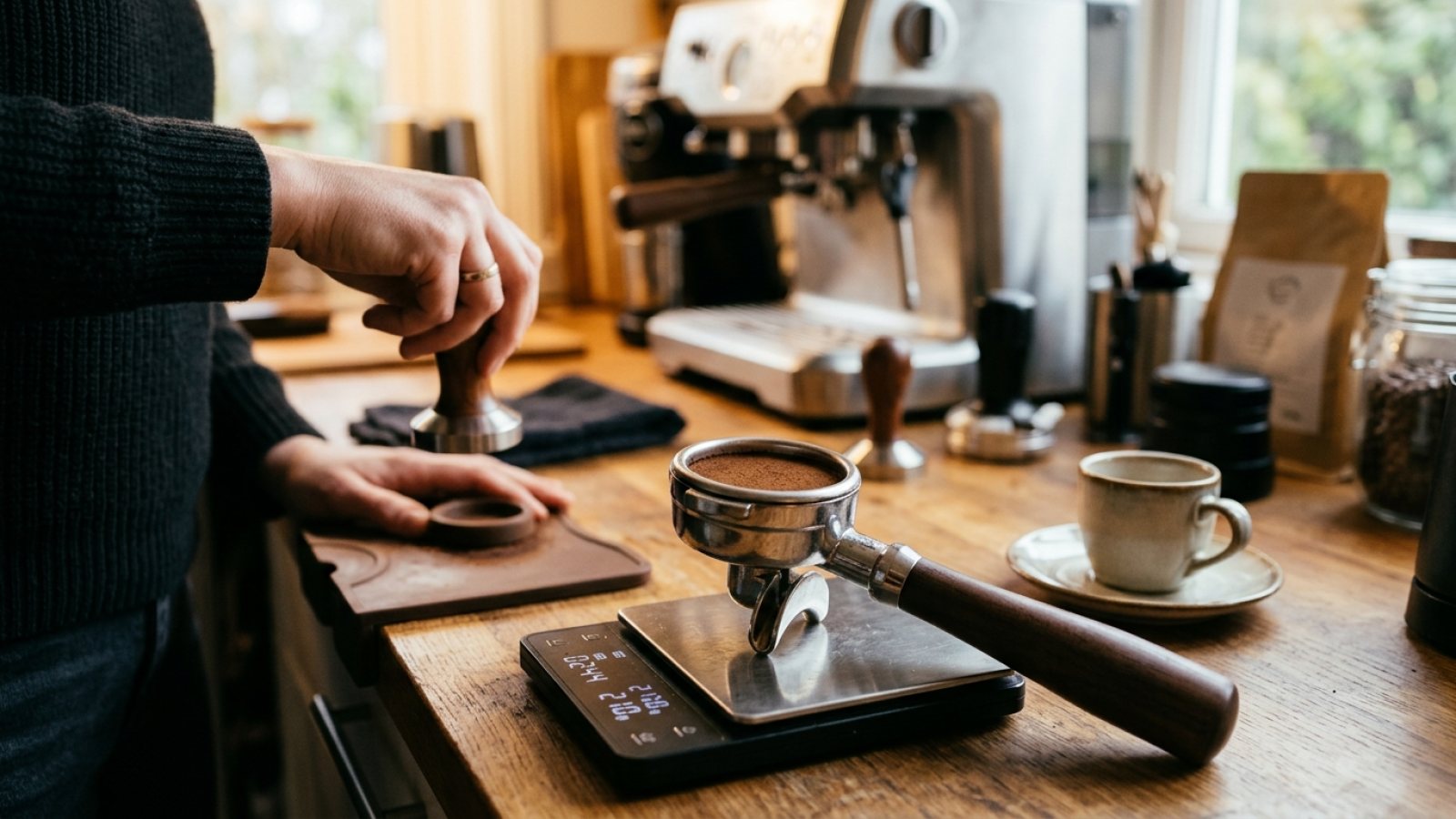
Tamping compacts your finely ground coffee into a uniform puck within the portafilter basket. Its purpose is singular: create resistance for the pressurized water, forcing it to extract evenly across the entire bed of coffee. An uneven tamp means water finds the path of least resistance, leading to channeling and under-extraction in some areas, over-extraction in others. The result is a bitter, sour, or watery shot – never balanced.
Forget the notion that brute force makes good espresso. Consistency and evenness trump excessive pressure. Aim for around 30 pounds of pressure, applied straight down, not at an angle. The real key is replicating that pressure and angle every single time. A calibrated tamper, which clicks or retracts at a specific pressure, is a wise investment for a home barista. Brands like Force Tamper or Pullman distribute pressure mechanically, removing human inconsistency. Your goal is a smooth, level surface, free of divots or loose grounds around the edges. Tamp, then give a gentle twist to polish the surface. Your grind size, typically like powdered sugar but not flour, directly impacts how easily this puck forms and how much resistance it provides.
The Gentle Awakening: Pre-Infusion
Pre-infusion is the act of gently saturating the coffee puck with low-pressure water before the full pump pressure kicks in. This isn't just a fancy feature; it's a fundamental step in achieving even extraction, especially with lighter roasts or denser pucks. When high-pressure water hits a dry coffee bed, it can shock the puck, causing micro-fractures and channeling. Pre-infusion mitigates this.
During pre-infusion, water slowly permeates the grounds, allowing them to swell and expand uniformly. This prepares the puck to better resist the subsequent full brewing pressure, reducing the likelihood of channeling and promoting a more homogenous extraction. Many home espresso machines, from the Rancilio Silvia Pro X to the Breville Barista Express, offer programmable or manual pre-infusion. A duration of 2 to 8 seconds is common, depending on the roast level and bean density. For a darker, fresher roast, a shorter pre-infusion (2-4 seconds) might suffice. Lighter, denser roasts often benefit from longer pre-infusion times (5-8 seconds). Observe your naked portafilter during this phase: the first drips should emerge evenly across the basket, not from a single point.
The Golden Rule: Ratios and Extraction
Espresso is a dance of dose, yield, and time, governed by the brew ratio. The "golden ratio" for espresso is a starting point, typically 1:2. This means for every 1 gram of ground coffee you put in your basket (the dose), you aim to extract 2 grams of liquid espresso (the yield). So, an 18-gram dose yields 36 grams of espresso.
This 1:2 ratio is a compass, not a rigid law. It typically delivers a balanced, classic espresso with good body and a sweet finish. However, different beans and desired tastes demand variation. A lighter roast, aiming for clarity, might benefit from a longer ratio like 1:2.5 or even 1:3 (18g in, 45-54g out), extracting more solubles and reducing acidity. A darker roast, prone to bitterness, might prefer a shorter, more concentrated ratio like 1:1.5 (18g in, 27g out), yielding a ristretto for intense sweetness and body.
Crucially, track your extraction time. For most ratios and medium-dark roasts, a target of 25-30 seconds, from the moment you hit the brew button (or from pump engagement post-pre-infusion), is ideal. If your 1:2 shot runs too fast (under 25s), grind finer. If it runs too slow (over 35s), grind coarser. Water temperature, ideally between 90-96°C (195-205°F), also plays a role in extraction rate and flavor. Many home baristas skip the scale for measuring yield. Don't be one of them. A good digital scale accurate to 0.1 gram is non-negotiable for consistent espresso.
The Iterative Art of the Pull
Tamping, pre-infusion, and the golden ratio are not isolated steps; they are interconnected variables that demand iteration. A slight change in grind size will impact the effectiveness of your tamp and the ideal pre-infusion time, all while shifting your target extraction time and ratio. Keep a journal of your doses, yields, times, and grind settings. Note the coffee origin, roast date, and flavor profile. This meticulous approach is how you move from merely brewing coffee to crafting espresso.
Your journey to perfect home espresso is continuous. Dialing in a new bag of beans will always require adjustments. Understand these three pillars, commit to precision, and your morning ritual will transform from a caffeine hit to a moment of genuine craft.
