
South Indian Filter Coffee: The Dabara-Set, The Froth, and a Strong Morning Ritual
South Indian Filter Coffee is a meticulously choreographed morning ritual, defining the start of the day across several Indian states. Its essence lies in a potent decoction, extracted slowly and frothed with practiced grace between a tumbler and its matching dabara saucer.
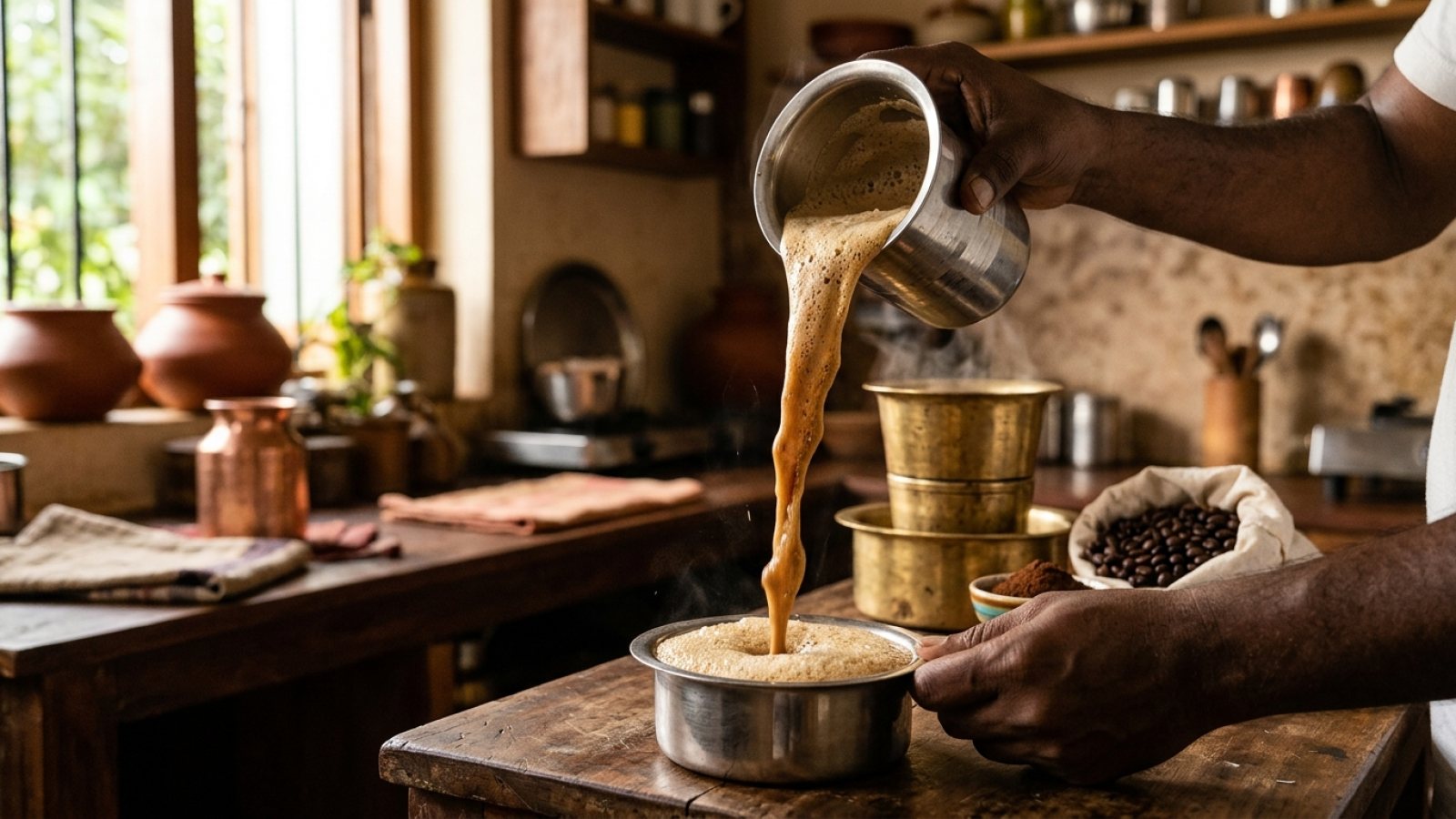
South Indian Filter Coffee is not merely a beverage; it is a meticulously choreographed morning ritual, a dark, sweet, and milky jolt that defines the start of the day across Tamil Nadu, Karnataka, and Andhra Pradesh. Its essence lies in the potent decoction, extracted slowly through a two-chambered brass or stainless steel filter, then frothed with practiced grace between a stainless steel tumbler and its matching dabara saucer.
The Anatomy of the Filter and the Blend
The apparatus for South Indian Filter Coffee is distinctive: a two-part metal filter consisting of a top chamber with a perforated disc where the coffee sits, and a bottom chamber that collects the concentrated brew, known as the 'decoction'. While traditionalists swear by brass for its heritage, a good quality stainless steel filter offers consistent heat retention and easier cleaning, a practical choice for daily use. The accompanying dabara-set, a wide saucer and a smaller tumbler, is indispensable for the aeration process.
The coffee itself is typically a dark-roasted Arabica or Robusta blend, often combined with chicory. Chicory adds body, a slight bitterness, and helps stabilize the foam. A common blend might be 80% coffee to 20% chicory, though some prefer 70/30 or even 60/40 for maximum intensity and a longer shelf life for the powdered blend. The grind is crucial: a medium-fine consistency, finer than drip, coarser than espresso, allowing water to permeate slowly without clogging the filter. Beans like Mysore Nuggets or Peaberry from Karnataka are frequently used for their robust flavor profiles.
The Decoction: Brewing for Intensity
Begin by preheating your filter with hot water. Place the powdered coffee-chicory blend evenly in the top chamber. Gently tamp it down with the provided plunger, creating a compact bed; do not over-tamp, as this restricts flow. Just a gentle press ensures even saturation. Boil fresh water, then let it rest for 30 seconds to reach approximately 200°F (93°C).
Pour about half of the hot water slowly over the coffee bed in a steady, concentric spiral, ensuring full saturation. Let this 'first decoction' drip for 10-15 minutes. This is the strong, concentrated essence. Once the first decoction has fully dripped, add the remaining hot water for a 'second decoction', which will be weaker but still flavorful. Some purists use only the first decoction, discarding the second or reserving it for later. For a standard 4-cup filter, use about 3-4 tablespoons of the blend for the first decoction, adjusting to taste.
The Pour and the Pull: Achieving the Perfect Froth
The collected decoction is intensely strong and rarely consumed black. It is mixed with hot, frothed milk and sugar. Now comes the iconic 'pulling' or 'meter' technique. Transfer the hot, frothed milk and the decoction into the larger tumbler. Pour the mixture repeatedly between the dabara saucer and the tumbler from a height of 1-2 feet. This vigorous action achieves several things: it cools the coffee to a drinkable temperature, thoroughly mixes the sugar, milk, and decoction, and most importantly, incorporates air, creating a rich, airy froth that sits atop the cup.
The height and rhythm of the pour are a matter of pride and practice. In many South Indian homes and cafes like MTR in Bangalore or Saravana Bhavan, this theatrical display is as integral to the experience as the taste itself. The foam adds a creamy texture and helps dissipate the heat gently. The bitterness of the coffee and the sweetness of the milk and sugar find equilibrium, delivering a balanced, robust cup.
South Indian Filter Coffee is more than just caffeine delivery; it’s an art form, a sensory experience passed down through generations. It demands patience and practice, but the reward is a uniquely rich, satisfying cup that grounds you in the present, ready for the day ahead. Master the pour, respect the decoction, and you will understand why this ritual endures.
