
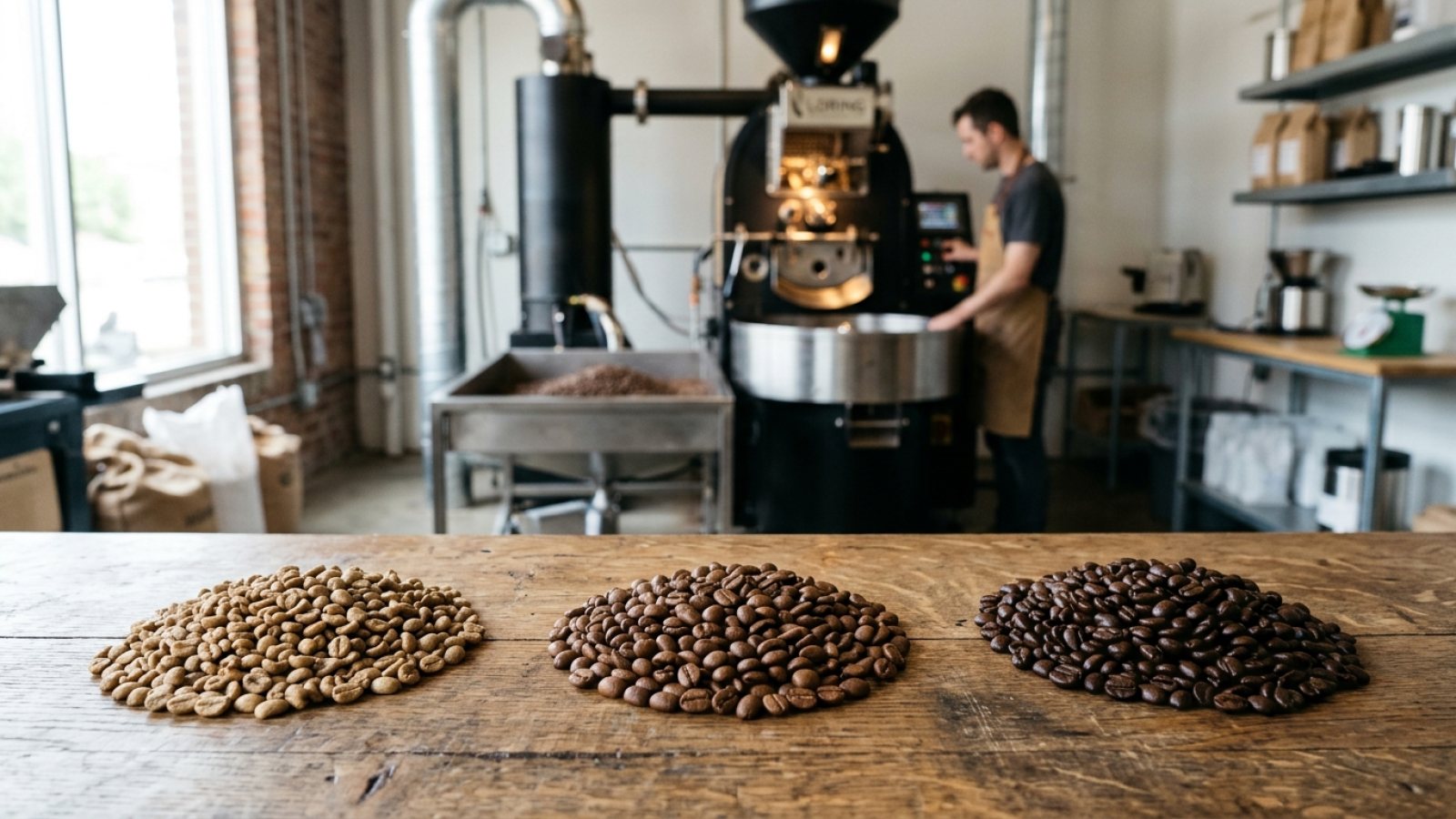
The Roast Spectrum: What Light, Medium, and Dark Really Mean for Your Coffee
Roasting coffee is not just a heating process; it's a careful orchestration that defines flavor, body, and acidity. Understanding the roast spectrum is crucial for crafting the perfect cup, whether you prefer bright fruit notes or rich, smoky depths.
Roasting transforms green coffee beans into the aromatic, complex nuggets we grind daily. This transformation is a journey through temperature and time, radically altering the bean's chemical composition and, consequently, its flavor. The labels "light," "medium," and "dark" are more than marketing terms; they are indicators of a profound spectrum of taste, body, and acidity that directly impacts your final cup. Understanding these profiles is the first step to brewing with intention.
Light Roasts: Clarity and Terroir
Light roasts arrest the bean's development shortly after the first "crack," before sugars fully caramelize and origin characteristics begin to fade. The internal temperature typically peaks around 380-400°F (193-204°C). This minimal development preserves volatile acids and compounds that express the bean's terroir.
Expect bright, complex acidity – often reminiscent of citrus or berries – alongside distinct floral or fruity notes. The body will be lighter, almost tea-like, with a clean finish. An Ethiopian Yirgacheffe, roasted light, will sing with jasmine and lemon. A lightly roasted Kenyan AA might burst with blackcurrant and grapefruit.
Brewing a light roast demands precision. For pour-over, use water at the higher end of the spectrum, 200-205°F (93-96°C), to ensure proper extraction of those dense, undeveloped cells. A slightly finer grind than you might expect for a medium roast is often necessary to achieve adequate solubility without under-extracting. Aim for a slower draw-down time, perhaps 3:30 to 4:00 minutes for a 30g dose. The goal is to maximize flavor clarity without introducing sourness.
Medium Roasts: The Art of Balance
Medium roasts hit their stride between the first and second crack, reaching internal temperatures of 410-430°F (210-221°C). This is where the Maillard reaction and caramelization truly shine. Sugars deepen, acids mellow, and the beans develop a richer, more rounded flavor profile.
Here, origin character still exists but is now complemented by roast-derived sweetness. Think milk chocolate, toasted nuts, and a balanced, pleasant acidity. The body becomes fuller, with a smoother mouthfeel. A Colombian Supremo often lands beautifully in this range, offering classic caramel and apple notes. A Brazilian Cerrado will present nutty, low-acid chocolate.
Medium roasts are the workhorse of the coffee world, incredibly versatile across brewing methods. For a French press, a coarse grind and a water temperature of 195-200°F (90-93°C) for a 4-minute steep will yield a full-bodied, sweet cup. For an AeroPress, a medium-fine grind with a 1:2 ratio and a 60-second immersion often creates a remarkably clean, balanced brew. This roast profile is forgiving, yet rewards careful attention to detail with consistent, delightful results.
Dark Roasts: Boldness and Bittersweet Depth
Dark roasts push past the second crack, often reaching 440-460°F (227-238°C) or higher, with oils migrating to the surface of the bean. The bean's cellular structure breaks down significantly, and the origin characteristics are almost entirely eclipsed by the roast itself.
The flavors are assertive: smoky, bittersweet chocolate, toasted marshmallow, sometimes ash. Acidity is very low, and the body is heavy, sometimes syrupy. A traditional Italian espresso blend, often containing Sumatran or Robusta beans roasted dark, delivers that intense, punchy shot foundational to espresso culture. Think of the robust character of a cup from a bustling Parisian brasserie or a classic NYC bodega.
Brewing dark roasts requires a different approach to avoid excessive bitterness. Use slightly cooler water, 190-195°F (88-91°C), especially for immersion methods like French press or moka pot. A coarser grind for French press or a slightly finer grind for an espresso machine (calibrated to your specific bean) helps manage extraction. For the Moka Pot, fill the boiler with hot water, add dark roast coffee to the basket without tamping, and keep the flame low for a gentle, even extraction. The stainless moka pot beats the aluminum for consistent heat distribution and longevity, especially with regular use.
The roast spectrum isn't a hierarchy; it's a map. Each profile offers a distinct journey for your palate, shaped by the raw material and the roaster's craft. Your personal preference, your brewing method, and even the time of day will dictate which profile suits you best.
Experimentation is key. Buy fresh, whole beans from a reputable roaster who specifies roast dates. Understand how your grinder affects particle distribution. Adjust water temperature and contact time. These are the variables you control. Taste, adjust, and discover the nuances. There is no single "best" roast, only the best roast for you, right now.
