
The Unsung Ingredient: Why Your Water Quality Makes or Breaks Your Coffee's Flavor
You obsess over bean origin, roast level, and grind size, but what about the 98% of your cup that isn't coffee? Your water quality is the most overlooked factor determining your coffee's true flavor.
You can meticulously select an Ethiopian Yirgacheffe, dial in your Baratza Encore grinder to a consistent medium-fine, and perfect your 205°F pour-over technique, yet still brew a disappointing cup. The culprit, more often than not, is the water.
We invest in expensive espresso machines, single-origin beans, and precise scales, but the most fundamental ingredient—the one that constitutes 98% of your brew—is often taken for granted. Water isn't just a solvent; it's an active participant, a flavor extractor whose composition dictates whether your coffee sings or falls flat.
The Science of Your Sip
Water is rarely just H₂O. It's a complex solution of minerals, gases, and organic compounds. The key players in coffee extraction are Total Dissolved Solids (TDS), hardness (calcium and magnesium ions), and alkalinity (bicarbonates).
Magnesium ions are excellent at dissolving flavorful organic compounds in coffee, enhancing sweetness and fruit notes. Calcium, on the other hand, can dull acidity and contribute to a chalky taste, especially in high concentrations. Bicarbonates act as a buffer, neutralizing the desirable acids in coffee too quickly, leading to a flat, muted profile. The Specialty Coffee Association (SCA) recommends a TDS range of 75-250 mg/L, with ideal hardness around 50-175 mg/L (as CaCO₃ equivalent) and an alkalinity of 40 mg/L.
From Tap to Taste: Practical Implications
Most municipal tap water sources fall short of these ideal parameters, often dramatically. Take Los Angeles, where hard water is common, loaded with minerals that can underextract coffee and quickly scale up your Breville Bambino Plus. Hard water prevents the coffee's aromatic compounds from fully dissolving, resulting in a thin body and a muted, sometimes bitter, taste.
Conversely, very soft water, like that found in some Pacific Northwest cities, can overextract coffee, pulling out harsh, sour notes and leaving your cup with a weak structure. Beyond mineral content, chlorine and chloramines, added to sanitize tap water, impart a distinct swimming pool aroma and flavor directly into your brew, ruining any nuanced notes your coffee might possess.
These aren't abstract issues. A carefully roasted Brazilian natural process bean, known for its chocolate and nut notes, can taste like burnt toast with high alkalinity water. An intricate Kenyan AB, celebrated for its vibrant acidity, becomes a muddy mess with overly hard water.
Solutions for a Superior Brew
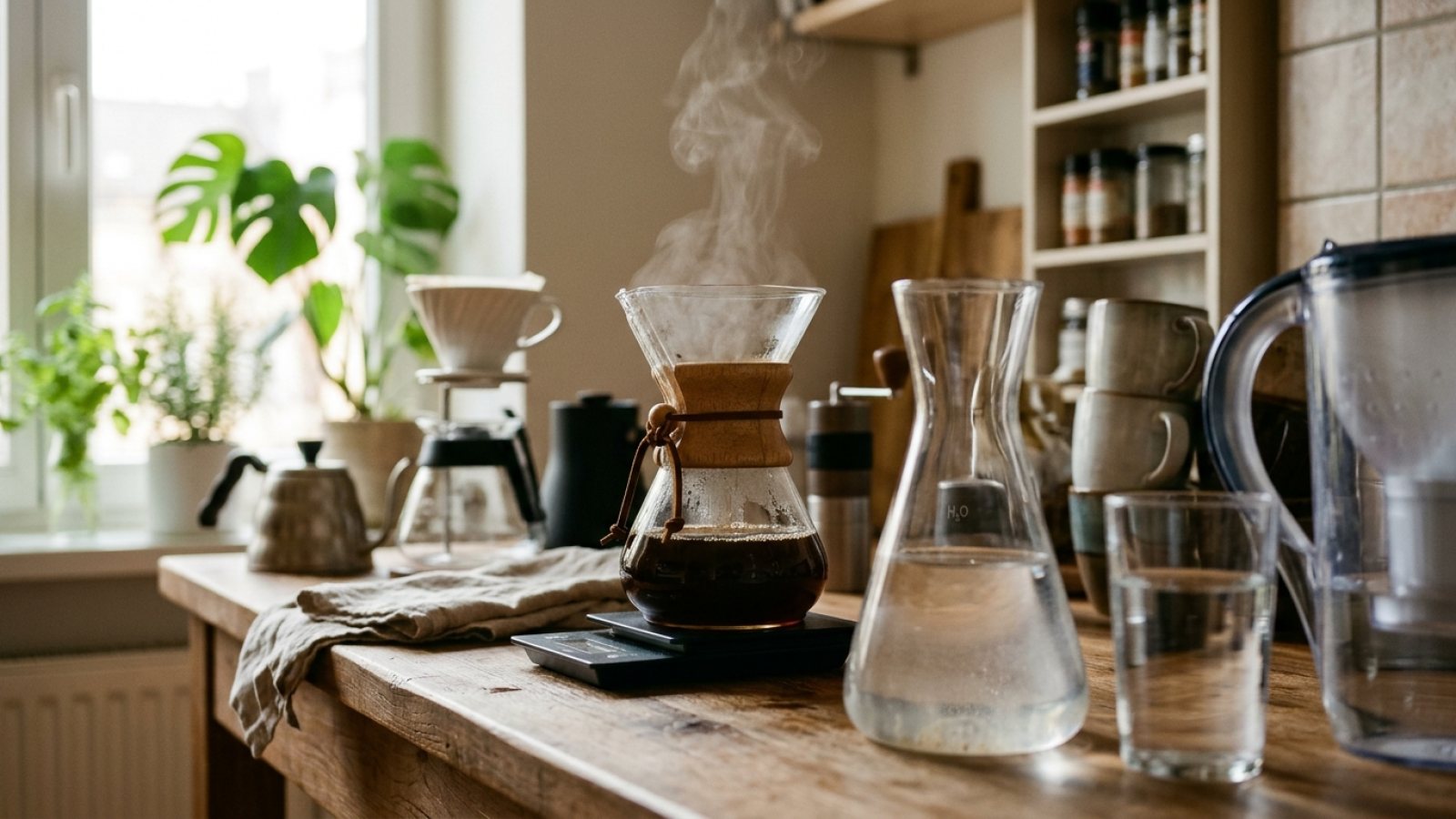
Improving your coffee water doesn't require a lab, but it does demand attention. The easiest first step is basic filtration. An activated carbon filter, like those found in a Brita pitcher or a whole-house filter, will significantly reduce chlorine and chloramines, immediately improving flavor. For mineral content, a reverse osmosis (RO) system offers the most control, stripping water down to near-pure H₂O. However, RO water alone is too soft for coffee; it needs remineralization. Products like Third Wave Water or Lotus Water mineral packets are designed to be added to distilled or RO water, creating an ideal brewing profile tailored for coffee.
For those without an RO system, certain bottled spring waters can be excellent. Brands like Crystal Geyser Alpine Spring Water, particularly from their Olancha Peak source, often boast a mineral profile closer to the SCA ideal. Avoid purified drinking water or distilled water unless you plan to remineralize it yourself. Cuban coffee, traditionally brewed in a moka pot, relies on a strong, robust flavor that can mask some water imperfections, but even a Cafecito benefits from clean, balanced water.
The Daily Grind with Better Water
Consider your brewing method. A sophisticated espresso machine like a La Marzocco Linea Mini will suffer catastrophic scale buildup with hard water, leading to costly repairs and inconsistent shots. For a pour-over, ideal water ensures an even, efficient extraction, allowing the specific terroir of the bean to shine through. The subtle aromatics that define a truly great cup are simply not accessible if your water is actively fighting against their release.
The takeaway is clear: treat your water with the same respect you show your beans. Test your tap water, filter it, or source a better alternative. The difference isn't subtle; it's foundational. Your next cup will prove it.
